
Your Local Mortgage Lender
Located in Tampa, Florida
Personalized Mortgage Experience
Moses Alford offers personalized service and loan options you'll love. We shop multiple lenders to find the best rate and product for you, getting you into your dream home faster.
With wholesale interest rates and cutting-edge technology, we make the mortgage process seamless. Trust the experts who focus solely on mortgages. Support your local community and experience elite client service.
Let us help you achieve your homeownership dreams!
The Home Loan Process
Mortgage Pre-Approval
Get pre-approved from one of our Loan Officers to see how much you can afford.
House Shopping
Work with a trusted Real Estate Agent to find a home you would like to move into.
Loan Application
Complete your home loan application to get the lending process started.
Don't take my word for it
Mortgage Programs
Experience the best mortgage experience located in Tampa, Florida.
Home Loan Options
Our experienced mortgage advisors will walk you through the best mortgage loan program that will fit your specific scenario.
Conventional Home Loans.
FHA Home Loans.
USDA Home Loans.
VA Home Loans.
Frequently Asked Questions
How often can I refinance my mortgage?
There is no limit to the number of times you can refinance. However, you must qualify every time you apply and there will be costs associated with closing the loan each time.
Can I buy a home if I do not have money for a down payment?
Yes! There are a number of bond programs that offer low or no down payment financing options.
How do I know which mortgage is right for me?
The key to choosing the right mortgage is to understand the range of options and features available to you, as well as your budget, circumstances, and goals. Our licensed mortgage professionals are here to help you navigate that process. The more you know, the more comfortable and confident you will be choosing the best option for you and your family.
How long will the loan process take?
The Truth in Lending Act (TILA) does not permit a lender to close a loan until at least seven (7) business days have passed from the date your application was received. A typical home loan takes 30 days, as a number of third-party services such as appraisals, title work, and credit are required in conjunction with the mortgage process. Once you familiarize your Loan Officer with the details of your specific loan scenario, they will be able to provide you with a more specific timeline.
Will I qualify for a home loan?
The only way to find out is to speak with a qualified mortgage professional. Our Loan Officers have helped numerous clients who didn’t know if they could qualify to become home owners. We take the time to understand your financial situation and long-term financial goals, and then match you with the loan program that best fits your needs. Your approval for a loan may also largely depend on the price of the home you are financing. Getting pre-qualified prior to beginning your home search can give you an idea of what you may be able to afford.
Why do people refinance their mortgages?
Homeowners typically refinance to save money, either by obtaining a lower interest rate or by reducing the term of their loan. Refinancing is also a way to convert an adjustable loan to a fixed loan or to consolidate debts.
How much money will I have to pay upfront to buy a home?
This question does not have a simple, one-size-fits-all answer. The exact amount will depend on the price of the home you buy as well the type of mortgage financing you choose. Depending on your loan program, your down payment could be as much as 20% of the home’s price or as little as 3%, while some loans require no down payment at all.
Can I get a mortgage after bankruptcy?
You may still qualify for a home loan even if you have experienced a bankruptcy. The best way to find out if you qualify is to talk with a Loan Officer to discuss your options. Be sure to bring all paperwork regarding your bankruptcy so your Loan Officer can find the program that best fits your situation.
Should I lock my interest rate now, or wait until we are closer to our closing?
Interest rates fluctuate all day, every day. If an interest rate is good, it may be in your best interest to lock now. If you wait, you run the risk of an increase in rates later. If you are concerned that rates may go down after you lock, contact your Loan Officer to discuss your options. Some programs allow you to lock for an extended period and choose to lower your rate should a better one become available.
Most Recent Blog Updates
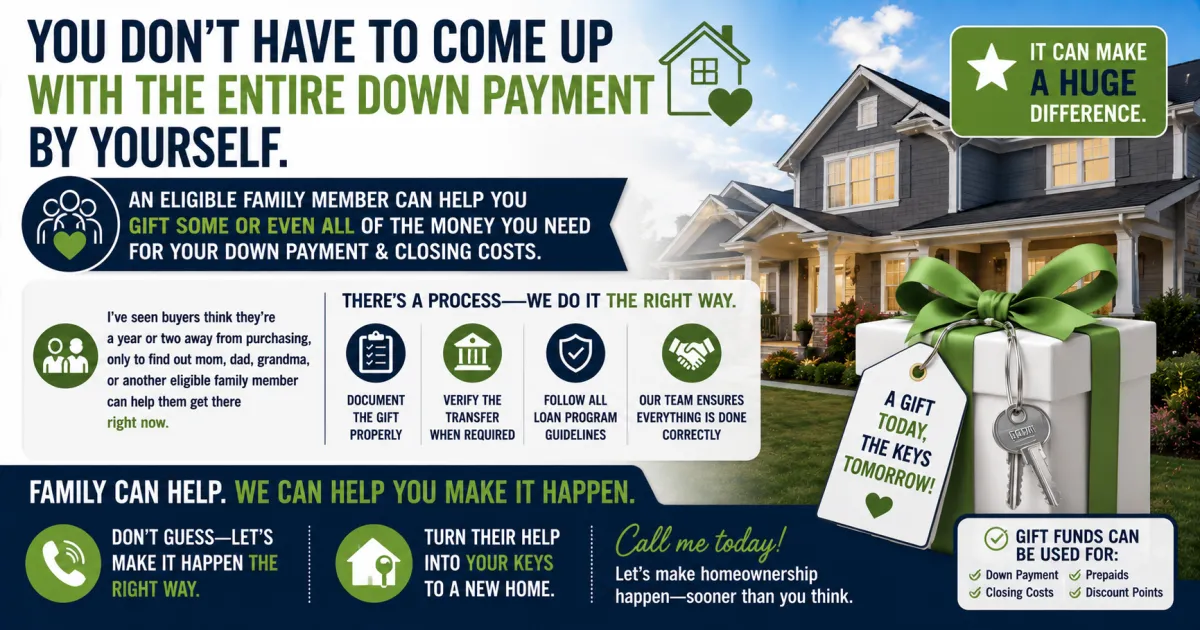
Family Can Gift Your Down Payment and Here Is How to Make Sure It Is Done the Right Way
The Down Payment Option Most Buyers Do Not Know They Already Have
Here is something a lot of buyers do not realize. You do not necessarily have to come up with the entire down payment on your own. Depending on the loan program an eligible family member may be able to gift you some or even all of the money you need for your down payment and closing costs.
That single piece of information has moved buyers from thinking they were a year or two away from purchasing to being ready right now. Mom, dad, grandma, or another eligible family member may already be willing and able to help. The only missing piece is knowing how to do it correctly.
Why Doing It Correctly Actually Matters
Grandma cannot Cash App you twenty thousand dollars the night before closing and hope for the best. That is not how gift funds work in a mortgage transaction and attempting it that way creates problems that can delay or derail a closing that was otherwise ready to happen.
Gift funds require proper documentation. The source of the funds needs to be verified. The transfer needs to happen in a way that follows the specific guidelines for your loan program. Different loan types have different requirements for how gifts are documented, when the funds need to be in your account, and what paperwork the lender needs from the donor. Getting the sequence and the documentation right from the beginning is what makes gift funds work smoothly rather than becoming a last-minute obstacle.
What the Process Actually Involves
Moses Alford and his team handle the gift fund documentation process so that the generosity your family is extending actually converts into a set of keys rather than a compliance problem at the closing table.
That means documenting the gift properly with a gift letter that meets the requirements of your specific loan program. Verifying the transfer when the guidelines require it. Ensuring the timing of the transfer aligns with what underwriting needs to see. And making sure the donor understands what is required on their end so there are no surprises that slow things down.
The process is manageable when it is handled correctly from the start. The problems arise when buyers or family members try to handle it themselves without understanding what the lender needs.
What to Do If Your Family Has Offered to Help
If a family member has said they would love to help you buy a house do not guess about how to make it happen. Call Moses Alford and his team to find out the right way to structure that help so it turns into the down payment you need and ultimately the home you want.
The call is the right first step before any money moves.
Sources
ConsumerFinancialProtectionBureau.gov
FannieMae.com
MortgageNewsDaily.com
HUD.gov
Investopedia.com

Mortgage Calculator
See your total mortgage payments using the tool below.
| Year | Interest | Principal | Balance |
|---|